

An Interview with One Piece Editor Eric Litman, ACE
We discuss his career journey, what makes for great editing, the creative process behind “One Piece”, his advice for those trying to make it in show business, and so much more!

A few months ago, writer Joshua Paul Johnson reminded me of the following mantra: every movie is a miracle.
When taking a step back to think about it, that observation rings true. To bring a film to life, it requires an insane number of contributions. From the director’s vision, to the writing of a script, to casting, to the making of the costumes and production design, to crafting a score that matches the vibe of the content, to the sound, to everything else that gets put in the end credits of a production, it’s a wonder that we ever see something reach the big screen, let alone the sheer volume of content out there. It’s like those often-loathed group projects in school, but on steroids. Not to mention the process of getting everything greenlit.
It begs the question: who takes all these components, all the raw footage from production, then puts everything together in a way that maximizes the magic all those moving parts bring to the table? That’s where editors enter the fold.
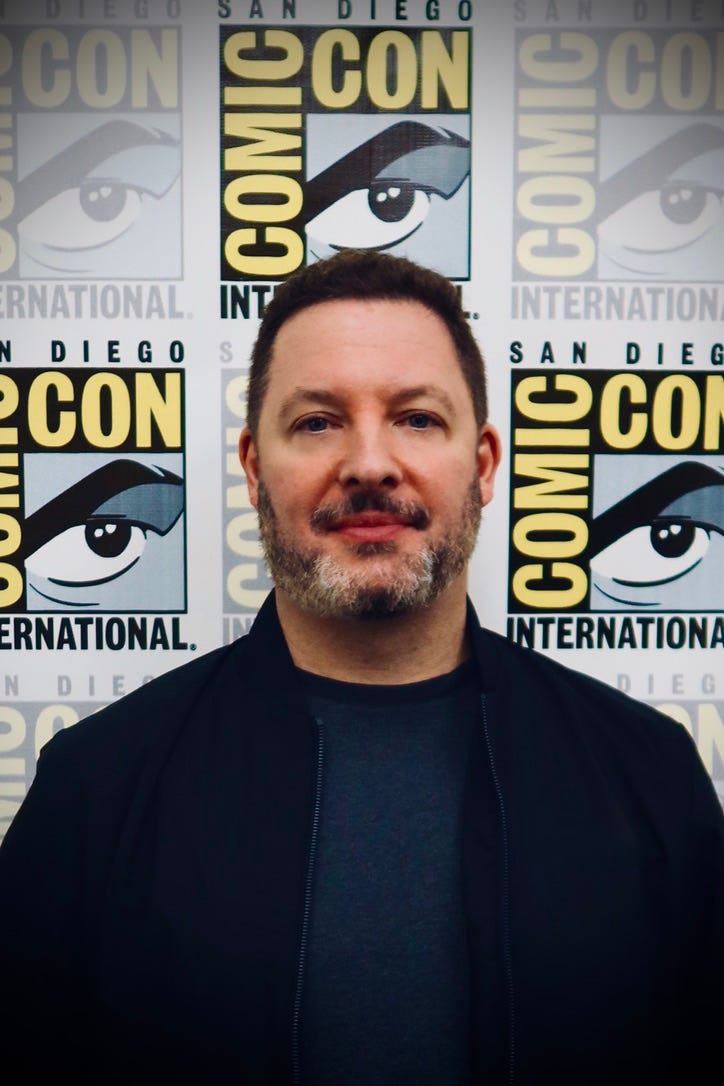
Which is why I am excited to speak to Eric Litman, ACE, who is an LA based editor known for performance driven storytelling, large scale world building, and shaping ambitious series from the ground up. A proud member of American Cinema Editors, Eric brings both technical precision and narrative instinct to every project.
Raised outside Philadelphia, he earned his BA in Film from Temple University’s Film and Media Arts School, followed by a Master’s in Editing from the American Film Institute Conservatory, where his focus on character, rhythm, and story was refined.
Eric came up cutting Marvel’s “Agents of S.H.I.E.L.D.,” Marvel’s first television series, where he helped shape many of the show’s most memorable premieres and finales while defining its editorial voice, before going on to edit a range of acclaimed and fan favorite series including “Black Sails”, “The Hot Zone: Anthrax”, “Body of Proof”, as well as “Magnum P.I”., “Charmed”, and “Star Trek: Picard”.
Eric also edited “Dope Thief”, produced by Ridley Scott and Peter Craig, a character driven crime series defined by tension, pacing, and sustained performance.
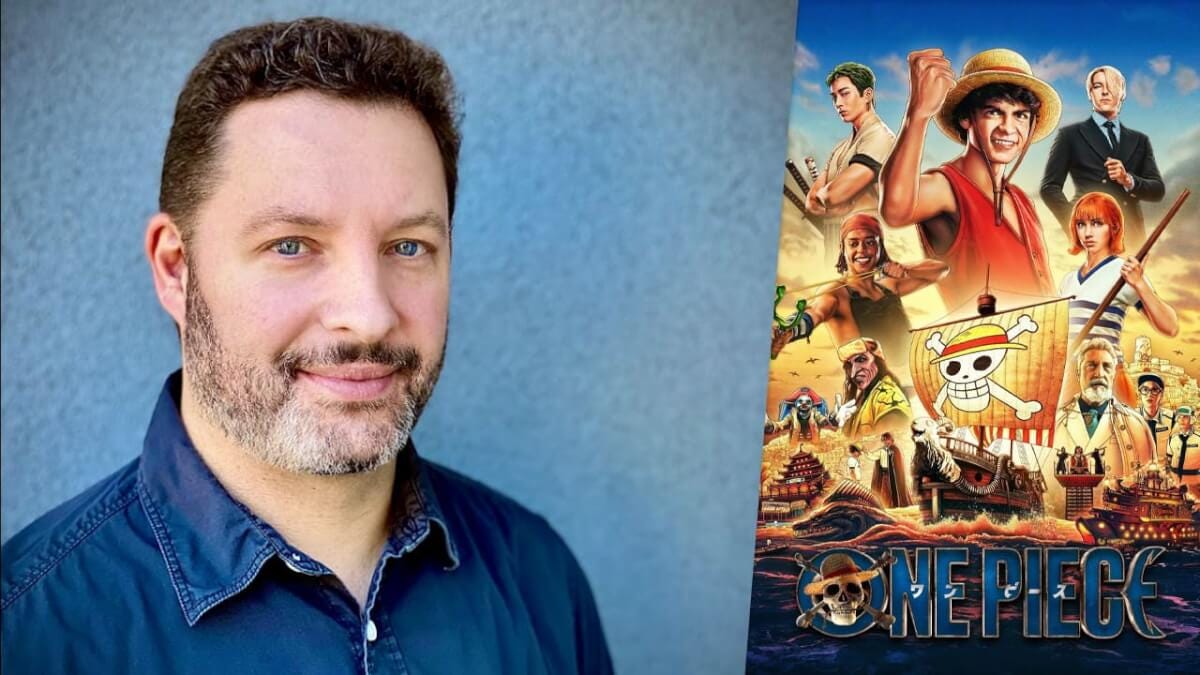
He recently completed Season 2 of “One Piece” for Netflix, a global series that balances epic scale with emotional clarity. Drawn to close collaboration with directors and creative teams, Eric gravitates toward projects that value strong point of view, disciplined storytelling, and character first editing.
To put into context the popularity of the last show I mentioned: the latest season, which premiered on March 10, 2026, debuted at number one on Netflix with 16.8 million views in just its first four days of being on the platform. Here is the plot synopsis of the show in case you are out of the loop on it:
The show follows Monkey D. Luffy and his Straw Hat Pirates on a quest to find the legendary treasure, the “One Piece,” which would make Luffy the King of the Pirates. In a world with a tyrannical government, Luffy, who has rubber-like powers, battles dangerous pirates and Marines in his ongoing quest for greatness.
Eric graciously offered up his time to speak to me about the world of editing. Eric was extremely friendly and thoughtful to talk to. I hope you take away as much from this conversation as I did!
Without further ado, let’s get to this interview!
What inspired you to get into editing?
I grew up outside of Philadelphia, and up until my early college years, I was a pretty serious art student in painting and drawing, with a little bit of sculpture. When I was applying for colleges, I was offered lots of art scholarships, along with a few full rides at some schools.
Along with a passion for art growing up, I was at the movies every weekend, either with my father or my friends. It was my place to go to. There were so many great movies that came out every week that I wanted to experience, and because of that, I had a deep love for cinema.
Like everybody, I wanted to be a director. That’s what I thought my path was. I didn’t realize at the time there were so many different other avenues in filmmaking. But early in my youth, I became exposed to a movie called “JFK”, which was a pretty influential movie for me in terms of editing. It showed me there is this craft out there beyond directing.
To be honest, when I first watched that film, I really didn’t know what I was looking at. I just saw something that really took me away. It was so unique in the way they told a story. So, when I eventually went to college, I decided that I wanted to put my art background a little bit to the side, and focus on a different medium, which was filmmaking. From that decision onwards, I loved everything that I was doing. I loved being on set, and I loved the physical nature of filmmaking.
But I also had this innate understanding of computers. I’d walk around with my Jaz drive, which at the time I think it was 500 MBs, which was a lot of space at the time. For whatever reason, I just loved the idea of working with computers. Then, I learned there was this thing called nonlinear editing.
At first, I didn’t know what that was. It seemed like some mad scientist technology. But, I just started playing with it on a really cheap computer at the film lab. As I used it more, I realized that the capability and the options just became endless. You could do so many things on this thing.
Looking back on it, what I was doing was probably terrible quality stuff. But the utility of it blew my mind. If I thought about something, if I had an idea, I could just do it. If I wanted to add a lens flare or a special effect, I could do it. That excited me to no end.
From there, I learned that there is this thing called film editing, and in film editing, there was still the old school way of actually holding and touching film, which I had done. But there was this other technology component that just really, really excited me.
I eventually went out into the workplace. I started out working on the East Coast doing lots of low budget type stuff, commercial work. I taught for a little bit then I eventually went to the American Film Institute (AFI) where I focused entirely on film editing. It was the only school at the time when I was going to graduate school, that offered a specific education in editing.
Once I finished there, I have been working nonstop in the film community ever since.
What in your mind separates the wheat from the chaff in terms of editing quality?
There’s a number of movies that I’ve seen in the last few years that exemplify excellent editing. I’d say most recently I just saw the movie “Sinners.” I made a point to see it projected in the theater. I think it was 70 mm, or a film format that’s not commonly used today.
I came to that party a little bit late, but I heard it was really good. I’m always skeptical when I hear stuff like that . But when I went and saw it, I was hooked from the first frame onwards. Which doesn’t happen too often to me.
One of the things that I noticed, obviously, was that the overall look of the film was great. You felt like you were in the deep south. You felt hot and sweaty. Everything about the look captured what they were going for.
I say this next part cautiously, because sometimes if I start noticing film editing or if I start noticing a technical aspect of a film while watching it, it means to me that I’ve checked out, but I found myself drawn to the technical aspect in this case. “Sinners” was a unique experience for me because I did start to notice the component that I typically try to tune out so I can fully immerse myself in the experience, but I started to notice it because I was so captivated by what I was seeing.
I saw some techniques that were being used that drew me in. Relatively simple stuff, like transitions from a guitar wail to a scream or stuff like that. But it was done in a way that moved the story forward. They used interesting techniques, and I saw there was a lot of restraint in terms of when to cut, when not to cut, when to let things play or when to cut to the next shot. Their editing approach fascinated me. It was a movie that I really, really enjoyed.
Then another one I saw many years, about twelve-some-odd years ago, was “Whiplash”. That’s just a terrific movie from an editing perspective all around. The editing played aggressively for a movie. It was done in a way, at least for how I would interpret it, where it felt like it was almost a character of the film. I thought that was pretty interesting.
Who would you say are some of your biggest role models that you’ve had and why?
I’m gonna go back to my “JFK” experience to answer this. After I saw the movie, I looked up the editors who cut that movie: Pietro Scalia and Joe Hutshing. I started to notice there were other movies that I was watching that I really enjoyed from them afterwards. I saw there was a bit of a style that was being used. It’s not necessarily that same aggressive flash cut editing that they use in “JFK”, but more in terms of how they were using their editing to really craft perspective and move the story forward.
I like watching the trajectory of filmmakers. I think anybody who knows me really well will tell you that I watch movies every day. I try to make a point to watch something every day. It may not be the whole movie, but I’ll definitely watch parts of it. I generally watch a lot of the same movies over and over. Some people say it’s comfort food, and that it’s relaxing.
I can understand that sentiment, and I sort of agree with that. But I like watching these movies over and over again because you always notice something new. You always see something different, and because of that, at least for me, I start becoming more in tune to the technique of what was being used for the story, the character, and the editing.
For example, with James Cameron: I love the way he paints the scene with light. Every shot in his film is beautiful. He’s using it to separate foreground and background and to also put an emphasis on a certain character. I think that’s such an interesting way of telling a story.
For my trajectory coming out of film school, to becoming an editor, I took the approach of assisting editors. I assisted a number of editors for many years, and I always learned something from each and every one of them. This includes different technical aspects, different storytelling aspects, different ways of interacting with people in terms of collaboration. So I’m fortunate in that I had a lot of really influential, strong people in my corner that were showing me the ropes.
One of your most recent works was on the Netflix sensation “One Piece”. What about the show’s concept drew you in?
To be honest, I was a comic book kid growing up. But less in the Manga realm, and more in the sense of Batman, Superman, Spawn, Spiderman, and the traditional stuff. I would go to comic conventions all the time. In Philadelphia, we didn’t have Comic-Con. We had a thing called Comic Fest. which I guess was the precursor to Comic Con. So, I was pretty in tune to that world.
Somehow, “One Piece” got by me. Maybe I was a little bit older when it came out. I’m not sure, but I wasn’t totally aware of it. Many years later, I sort of heard something about it, though I was older when I did.
I worked on a show called “Marvel’s Agents of S.H.I.E.L.D” for the whole run. When that show came to an end, I heard there was a friend of mine, Matt Owens, a producer/story editor on that show, who I heard through a rumor that he was developing a show called “One Piece.”
He and I worked on several episodes together, so I reached out to him and I said, “this show sounds really interesting. Keep me in mind.”
And he was like, “already on it. Done. When it’s time, we’ll reach out to you.”
A number of years went by, then there was the pandemic. I sort of thought the show just went away.
And then one day I got a call. He said, “hey, we’re sort of gearing up now. Are you available? And I said, “yeah”.
By then, I started reading some of the Manga. I watched it along with the existing anime series, and I thought, “wow, this is really out there. This is so different and unique.” At the beginning, I had these feelings that this was coming from left field. My initial reaction was, “I’m not sure about this.”
But then I thought, “well, wait a minute. There’s something interesting here. If you’re having that reaction, dig a little deeper. Let’s explore this some more, because you’re thinking about it, and it made an impression on you.”
So, I did just that. Matt told me they were referencing more of the Manga as opposed to the Anime. So, I started reading more of the Manga, and like everybody else in the world that’s a fan: I got hooked.
It’s such a genre bending type series, so by this point, I was really interested in working on “One Piece”. I wanted to hear how they were going to execute this show. I just wanted the meeting with Matt because I was curious to hear how it would be done. If I landed the job, great, but if not, I would watch it out of sheer curiosity, because it’s so unique.
You have so many different types of genres blending together to create the magic of “One Piece”. It’s also inspired by Tarantino and all these other different references. After a while, I could not put this Manga down. By this point, I thought, “if they execute this show properly, (which they ultimately did), it’s gonna be a major success.” So, when I signed on to work on the show, I was ecstatic. I wanted to play a role in bringing its uniqueness together.
As you mentioned, it’s a very genre bending type of show, and it sounds like, at the outset, a very challenging project to take on. How did you overcome some of those challenges?
Once I was on the show, the moniker we always had was that we wanted to keep everything grounded. But we wanted to balance that by making sure that there’s this fantastical element to the show as well. Anime hasn’t always translated well to live action in the past unfortunately because they could not maintain that equilibrium I just mentioned.
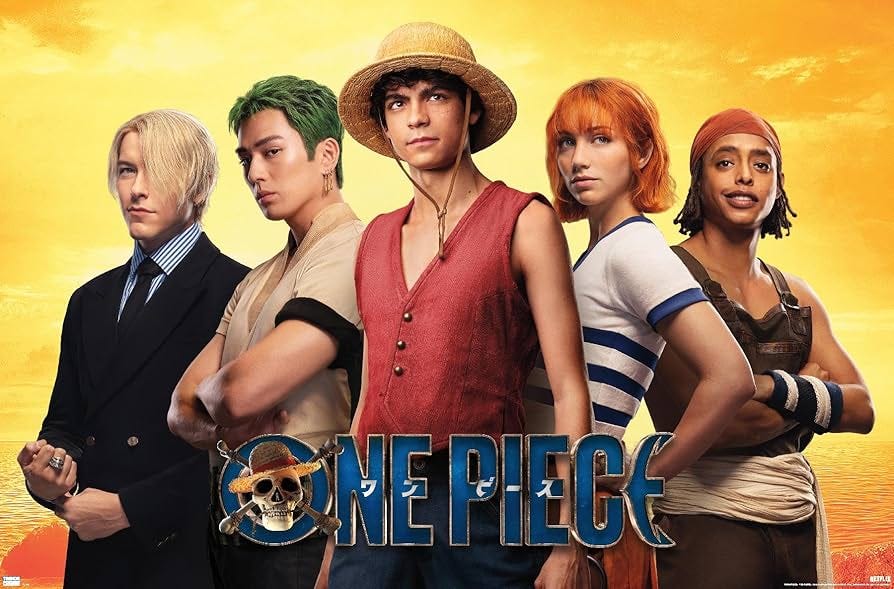
We have a guy made of rubber, we have a master swordsman who has green hair. We have all these different characters out there that can do some pretty wild stuff. But at the end of the day, we always wanted to make sure we were grounded in reality, which allows you to connect with the characters, and is ultimately what the Manga did. You always want to make sure your audience connects, feels the emotion and actually cares about these characters.
One of the trickier things we did in “One Piece” season two was when we edited the scene where Luffy’s interacting with a whale named Laboon, a whale the size of the Empire State Building. For a variety of reasons, that was a deeply emotional episode. It was one of my favorites to put together because there’s lots of fights, there’s lots of action, but the way Luffy overcomes everything with Laboon is through connecting with him on a personal level.
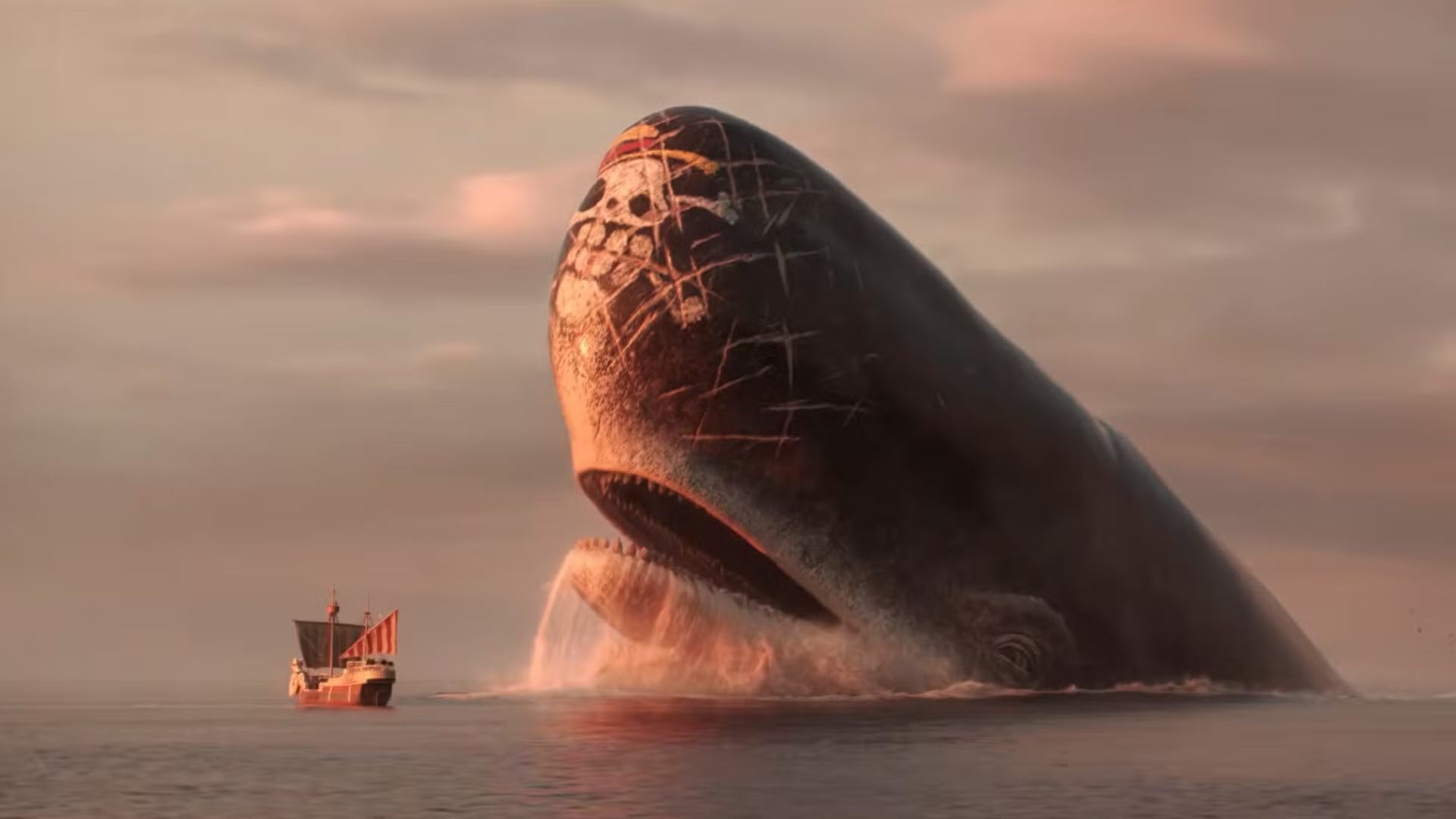
Similar to Luffy, Laboon was left behind by his pirate crew. So, they had this deep connection there. When we were putting everything together, especially that end scene when Laboon’s having the flashback with Brook (the pirate that abandoned him), We tried so many variations of that little section.
The note we always had was, “we’re close, but we’re not crying yet.” Until eventually, we made somebody cry in the cutting room. That’s when we knew we accomplished that deep connection, that we made this scene land and that the payoff, for everything that’s led up to this moment, is right here.
Many people who tell me they’re fans of “One Piece”, and especially the fans of the live action, they all say the same thing: I cried during that episode with Luffy and Laboon.
It feels great that we achieved the desired effect.
What was the secret sauce to making the magic of that scene in Season Two happen?
We were using shots of Laboon’s eye to show his reaction to Luffy’s singing of a song near and dear to his heart. Now, keep in mind, when we were putting that sequence together, we had very rudimentary shots. Obviously, we didn’t have a whale the size of the Empire State Building to work with. So, Luffy’s playing off that scene against a blue screen. There’s nothing there. I think it was in a parking lot where we shot his part.
We eventually started getting some pre-biz shots of Laboon. We were trying to mock it up, and we were really dialed into the making of Laboon, because a lot of that is just close-ups of Laboon’s eye. Throughout the making of the scene, we were dialed into the following questions: what is his eye doing? Where is the focus of his eye? When does he blink? How many times does he blink? Where is he looking up? Is he looking down? When does he have the moment of realization that the song that Luffy is singing is the same song that he heard from the Rumbar Pirates that left him?
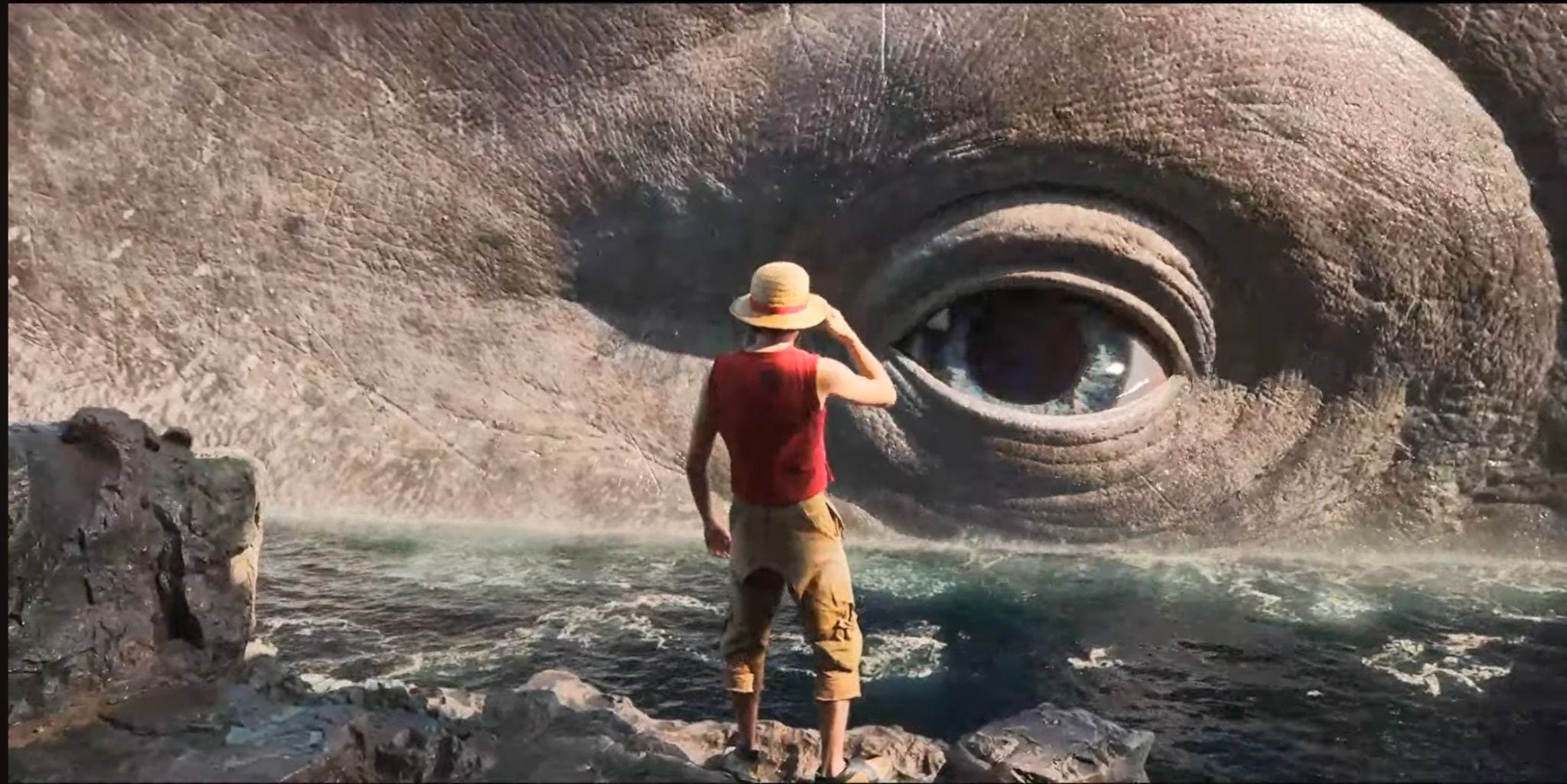
So, we were focused on really detail oriented stuff pertaining to the frame of what Laboon’s eye is doing. But also, what Luffy was doing. We needed to ask some important practical questions for him as well: what’s he doing in this moment? Is he taking it in? What is he realizing? Is he fearful? Or does he know he succeeded?
The way we were dialing it in with Luffy was through very thorough calibrations of his arc in that moment. He’s desperately trying to save his crew. He thinks they could be dead or that they’re about to die. But every time Laboon submerges, He could also die. Laboon could swipe them off into the ocean and the sea water is not good for people with his type of powers. So, that would have been a problem.
For every frame of that scene, we were really careful about telling the journey of Luffy and Laboon in a compelling way, while also being careful in how we were showing the flashbacks of Brook, so that we understood that Laboon was connecting there.
How would you say the editing has evolved over your time working on the show?
We started both seasons with the same mantra: that everything is always grounded in reality.
We had a lot of fight sequences in season one and season two. In season one, we had a sequence where Zorro’s climbing out of the well, and he’s having all these flashbacks of how he got to where he is. We need to answer some important questions: What was his journey of becoming the swordsman that he is? Who was his inspiration?
Well, it was Kunia. And she ultimately had an accident and she dies. During that time, he made a promise to her that he was going to be this master swordsman. So, that whole sequence in season one of him as a young man, then all the sparring that he had with her, and then ultimately him falling in the well and coming out. Those were all scripted shots and we edited them in a very linear sense. They were fine scenes. Everything played great.
But then, somebody said, “hey, is there a way to intercut all this stuff? What if we alternate between various scenes happening simultaneously in different locations?” So, we investigated that, and we ended up doing that instead. It worked out really well.
Flash forward to season two, we knew by this point that we’ve done some of these techniques like intercutting, and we knew that they were really effective. So we started playing more with that. We asked ourselves: how do we use those techniques and apply them to season two?
There’s this whole sequence in episode two, where the straw hats are on the inside of Laboon. Luffy’s trying to save them. Laboon’s crashing. We have all these flashbacks of what Laboon is seeing. It was a very similar style in how we were doing that compared to season one. We were doing all these intercuttings to constantly ramp up the emotion, and constantly ramp up the actions so we could eventually reach an apex.
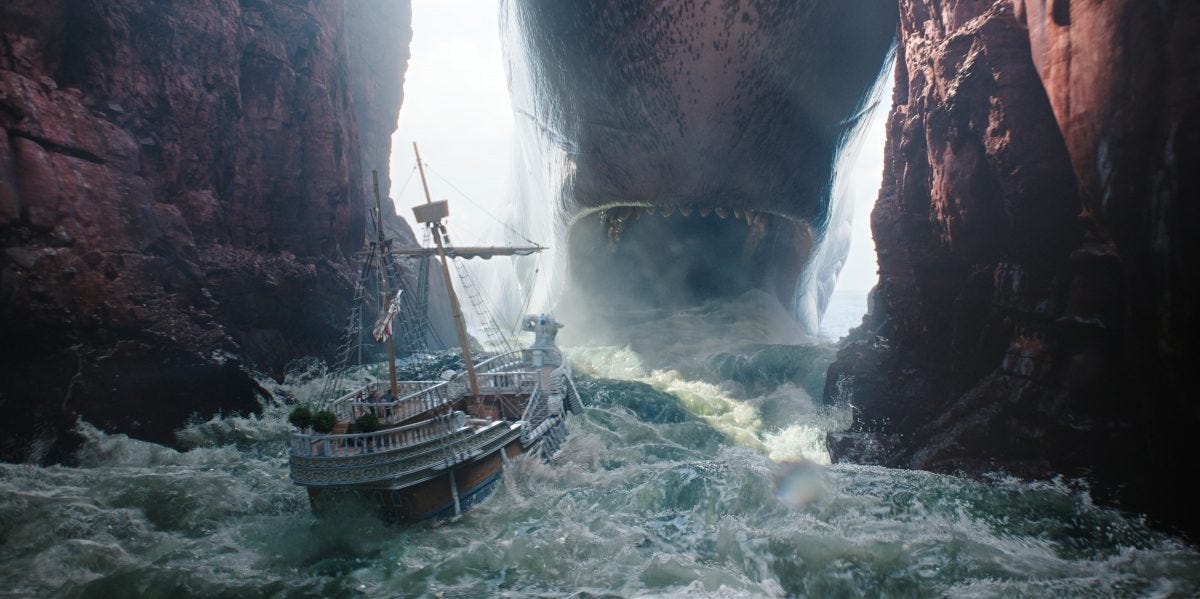
Also, we used a similar sequence in episode five, when, Zorro, Nami, and Vivi are on the candelabra. From there, Luffy and Usop come to save them. That whole fight sequence was scripted and shot as one long, continuous piece.
But when we saw it, we were like, “yeah, that’s playing well, but it starts to become a little languid. How do we ramp this all up?” So we decided we could start intercutting. And what we found was that as we were intercutting, it kept everybody active all at once.
Similar to what happened inside Laboon, similar to what happened to Zorro and the well, were constantly ramping up the emotion. We were constantly ramping everything up, and we eventually reached the apex that they’ve succeeded. It’s such an interesting technique, and I loved how this was all figured out through editorial in the cutting room. That, to me, is always very fun when you can start doing stuff like that.
How long was the editing process for season one and season two of “One Piece”?
Very long. Each season took well over a year to edit. The production side of things where they shoot each episode and put it all together took a few months.
But “One Piece” is a heavy visual effects show with a lot of sound and music. So as all these different elements are eventually coming in, we were constantly adjusting the cut. We were constantly changing things to allow certain parts to breathe.
We were always strategizing about various things, saying things like, “when the music comes in, if we had another beat here on this shot, we could finish this phrase of music, and it would be a really nice moment.”
Same thing with sound, and definitely with visual effects. As visual effects were coming in, we would realize, “well, we might have cut this a little too tight. These are really cool shots. What if we open this up a little bit and let this moment land a little bit longer?”
Or, we’re looking at it, and we’re like, “well, we’re in this part a little too long. It’s starting to feel like we’re belaboring the point. What if we trim this up, but then we can use that section a few cuts later?”
It becomes a give and take on big visual effect-oriented shows like this. You’re constantly going back and forth. It’s a constant conversation. The collaboration never stops.
What are the biggest things that you’re hoping viewers take away from watching “One Piece”?
I always want people on any show that I work on, regardless of its visual effects or non-visual effects, its heavy action, non-action, to always connect with the story.
As an editor, we are the central hub of the filmmaking process. We take the screenwriting, the directing, the acting, sound, visual effects, score, and more and bring it all together. I look at that as my responsibility to tell the most effective story possible.
I always want the story to resonate as best as possible. If somebody doesn’t notice the editing, I think that’s a compliment. It means that you, you know, you did your job. That said, if somebody in my field does notice the editing, much in the way I did for the film “Sinners”, I think that can also be a compliment.
At the end of the day, I just want people to feel immersed in the worlds I am a part of bringing to life, whether they recognize my work or not.
From a future goals perspective, what are some things that you’re hoping to achieve?
I want to keep telling interesting stories. Stories that are captivated by people. I hope that audiences watch the content I work on and have the same connection that I did as a young man going to the theaters and watching these movies that really shaped me and influenced my life for the better.
I want to be part of projects that have people walking out after the fact going, “I vividly remember seeing the movie, and it left a lasting impression on me.”
For example, after I watched “Batman”, I thought to myself: I want to be Batman. It left this powerful impact on me, as did other films like “JFK”. After I watched that movie, I walked out of the building going, “oh my goodness, the world is so scary out there.” “Sinners” possesses that same “x-factor” for me as well. I walked out of the theater going, “WOW”, which is not something I do very often.
Cinema can be so powerful just across the board. The impact it can leave on people and the way it can shape people is unlike any other. It inspires me every day.
But it’s being lost. It’s something we need to be conscious of. The film industry is at a crossroads right now. We must preserve the movie going experience. It’s actually very important, not just from a business standpoint, but from an artistic standpoint. And from a community standpoint: great movies and shows can bring people together in more ways than we can imagine.
What are your biggest pieces of advice for anyone trying to make it in show business?
Patience and perseverance are crucial. That would be the most valuable advice I could offer. You need patience because success in this industry doesn’t happen overnight. Unless you’re that once in a generation talent.
But for most of us, especially for someone like me, it took many, many years. It took a lot of different experiences, a lot of education, and it took some failures that I needed to learn from so I could understand why something didn’t go the way I wanted it to in order to prevent it from happening again.
Perseverance also comes along with that. I didn’t stop. I didn’t give up. And I think that’s a very, very important skill. So many people try something, and when it doesn’t work out they go, “oh, that just wasn’t for me.”
But in most cases where that happens: that was one of your first go around with it. You need to, you need to keep doing this. It’s not that I don’t ever say those types of things, it’s a natural sentiment when something doesn’t work out.
But I challenge people (including myself) to do this: the next time you try something and it doesn’t work out, when you wake up the next morning, get up and do it again.
Is there anything that we haven’t covered that you would like to mention?
I’m deeply proud of my work on “One Piece”. I really enjoyed going to the premiere downtown for season two and seeing all the fans dress up in cosplayer outfits, connecting with them and just seeing what this show means to people. When you’re editing, you’re deep in the notes and the weeds. You’re insulated from everything. You hope it’s going to be good, you think it’s going to be good, but you don’t really know until it is released to the public. So, seeing the positive reception and stories from people as to how the show impacted them for the better means the world to me.
I also recently went to Wondercon and did a panel there. I saw so many people dressed up as all these different characters. I started talking to some of them, and I realized that the show means something to so many different people for so many different reasons. It reminded me how I felt as a young man, going to the movies every weekend. I could see that same feeling in people’s eyes that I had growing up and watching films that inspired me. It’s amazing to see my life come full circle in that sense.
Eric, thank you very much for your time today! It was an absolute pleasure learning about your creative process in the world of editing. Be sure to check out “One Piece” seasons one and two on Netflix, along with all of his other works, when you get a chance!
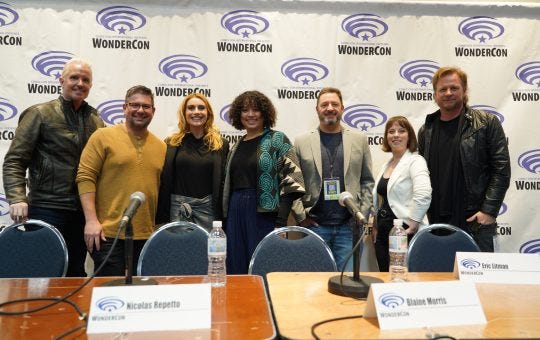
“I want to keep telling interesting stories. Stories that are captivated by people. I hope that audiences watch the content I work on and have the same connection that I did as a young man going to the theaters and watching these movies that really shaped me and influenced my life for the better.”
I am a fan of One Piece, so I was so excited to read this.
This was such a strong interview because it balanced technical insight with genuine emotional curiosity about storytelling.
The sections about editing “One Piece” were especially compelling because they revealed how much emotional calibration happens beneath large-scale spectacle. The discussion around Laboon’s eye movements, timing, reaction shots, and intercutting really highlighted how editing shapes feeling as much as narrative.
I also appreciated how thoughtful Eric Litman was throughout when discussing collaboration, restraint, pacing, and audience immersion. His perspective on editing as the central hub connecting performance, sound, visual effects, music, and story gave this conversation real depth.
The interview also carried a quiet respect for cinema itself that stayed consistent from beginning to end. That sincerity made the entire piece resonate.
Fantastic work. Insightful, detailed, and deeply engaging for both film lovers and creatives building anything collaborative.